



Some home libraries arrive by inheritance. Most get built one Saturday at a time, from racks where nothing is sorted and the hardcovers share a shelf with a bread machine. That is not a problem. A good thrift-built library comes from a routine rather than luck: knowing which sections pay off, judging a book's condition in a minute or less, and spending your money where it buys reading instead of decoration. Here is that routine.
Shop the Right Stores, Not Just the Nearest One
Not every thrift store deserves a weekly visit. Large chain shops with a dedicated book section price higher and cull harder, because someone is paid to know roughly what the books are worth. Smaller charity shops — hospital auxiliaries, church basements, animal shelters — tend to have the oddest and cheapest stock, and the volunteers who sort donations will often tell you which day the books come out. Ask. Most will say something like, "Tuesdays, after nine."
Three sources frequently beat thrift stores outright: Friends of the Library sales, where the final hours sometimes turn into fill-a-bag pricing; estate sales on the last day, when sellers would rather move boxes than pack them; and the clearance cart or free box outside a used bookstore, which is where damaged-but-readable copies end up. Go early for selection, late for price.
Judge a Book in About a Minute
You cannot read a book in the aisle to decide whether it is worth two dollars. You can run the same four checks every time.
The spine and the gutter
Stand the book on its tail and look at it from the top. A spine that leans or curves is "cocked," usually from years of bad storage, and it will only get worse with handling. Now open to the middle and lay the book flat on your palm. If you hear a crack, or see a visible gap between the page block and the inside of the spine, the glue is failing. Check the hinge at the title page as well; that is the first place a heavy hardcover tears.
The pages and the smell
Look at the edge of the text block. Brown speckles, called foxing, are cosmetic. Wavy pages and a faint tideline along the bottom edge mean water damage. Then smell the book near the spine. A musty smell that fades in a minute is just old paper. A musty smell that stays in your nose is mildew, and mildew spreads to the books you already own. Leave that one behind, particularly if someone in your house has allergies or asthma; if a musty book makes you wheeze, that is a question for a doctor rather than a cleaning tip. Also check for missing maps, plates or indexes, and remember that ex-library stamps and barcodes are fine on a reading copy and not fine on a collectible.
Editions and marks
Book club editions are often slightly smaller than the original, carry no price on the jacket flap, and may say so right there. Remainder marks — a marker stroke or a dot on the bottom edge — mean the publisher sold the book off cheap. Neither is a reason to walk away if you want to read the thing, but both matter if you are buying to keep something nice.
Spend Where It Counts
- Buy freely: classics, essay collections, poetry, older mystery and science fiction paperbacks, and cheap editions of books you would otherwise read on a screen. Plentiful, inexpensive, usually in decent shape.
- Buy with a look: cookbooks, gardening, woodworking, knitting and other hobby titles. Older editions are often better written, but check that measurements, growing zones and safety advice still match current practice.
- Buy only if clean: children's picture books. Watch for crayon, torn pages and missing pop-up pieces; board books usually survive a wipe.
- Skip: heavily highlighted textbooks, outdated travel guides and software manuals, abridged classics, and anything that smells. A dollar is not a bargain if the book goes straight back to the donation pile.
One habit worth keeping: before paying more than a few dollars in a shop, check what the same used title sells for online. Sometimes the thrift store wins, sometimes it does not.
Organize the Shelf So It Stays Readable
A library you cannot browse is a stack with pretensions. A few decisions do most of the work.
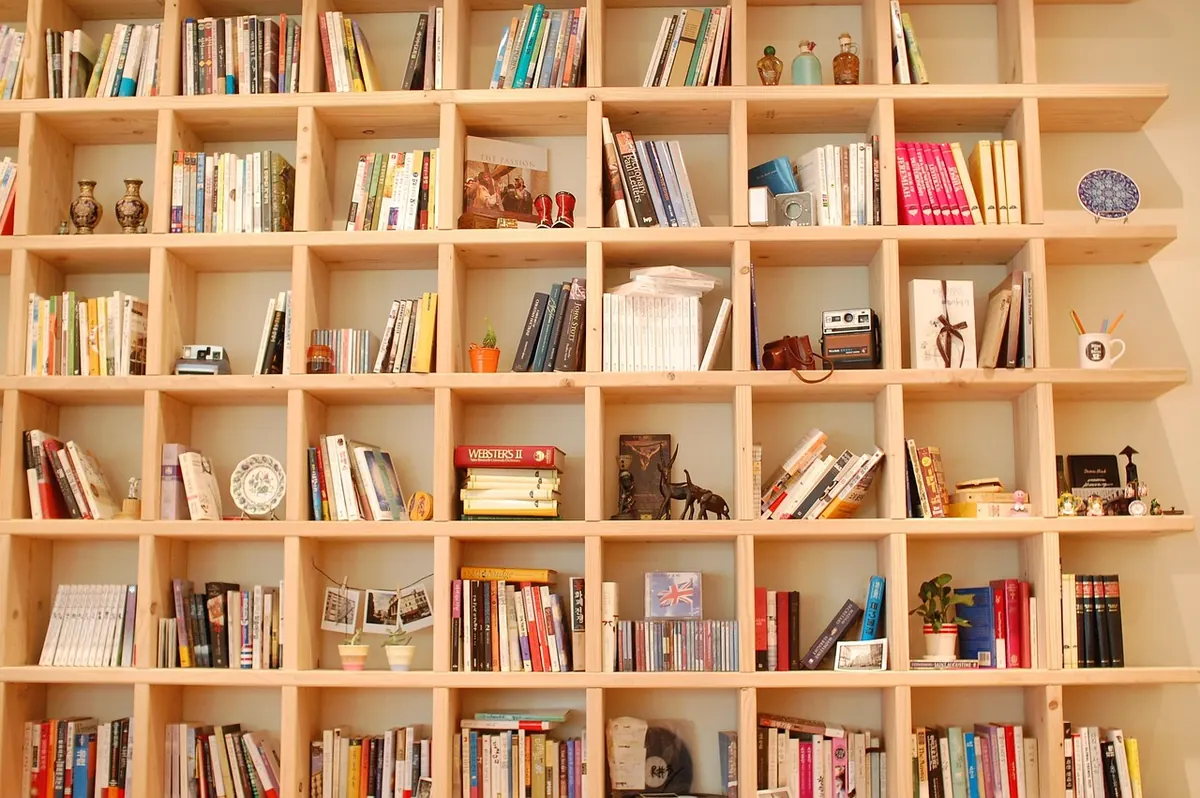
- Sort by subject, then by size. Fiction together, reference together, children's books low. Within a subject, put short books beside short books and tall beside tall so nothing leans.
- Store upright whenever possible. A heavy stack of hardcovers presses down on the spines of the books underneath.
- Choose a shelf with a center support. Long shelves sag under weight; the braced one outlives the cheap one next to it.
- Keep books off the floor and out of direct sun. Damp basements and exterior walls invite mildew, and sunlight bleaches spines within a season.
- Leave a finger's width of air. Crammed shelves make pulling one book out a chore, and you stop pulling.
If you would rather not sort at all, a single "read next" shelf is a legitimate system. Whatever you plan to read in the next few months goes there. Everything else is archive.
Make the Corner Worth Sitting In
The books are half the job. The other half is a chair you actually like, a lamp that throws light over your shoulder rather than into your eyes, and a small table for a mug. Keep the shelf you browse most at arm's reach from that chair, and give yourself a basket or a low shelf for the current pile so the rest stays tidy. You do not need a full wall of built-ins to have a library. You need one corner where reading is the easiest thing to do.
Keep the Budget Honest
Set a monthly cap before you walk in and treat it as firm, not aspirational. Carry cash, since a finite wallet enforces the rule better than willpower. Bring a short list of authors or subjects you are hunting, but leave room for one surprise. The cheapest books per dollar are almost always at bag sales and library clearances, so save your money for those and buy single volumes sparingly in between. If you want a simple brake on overflow, adopt one-in-one-out: a new arrival means one book leaves for a friend, a little free library, or a donation bin.
Start With One Shelf
Pick a single subject you genuinely read — twentieth-century mysteries, garden design, Civil War history, whatever it is — and go looking for six books. Then stop. Come home, check the spines, wipe the jackets with a barely damp cloth, and shelve them. Next month, do it again. A home library built this way stays affordable, stays readable, and ends up looking like a person rather than a purchase order.
Photo: superjhs / Pixabay